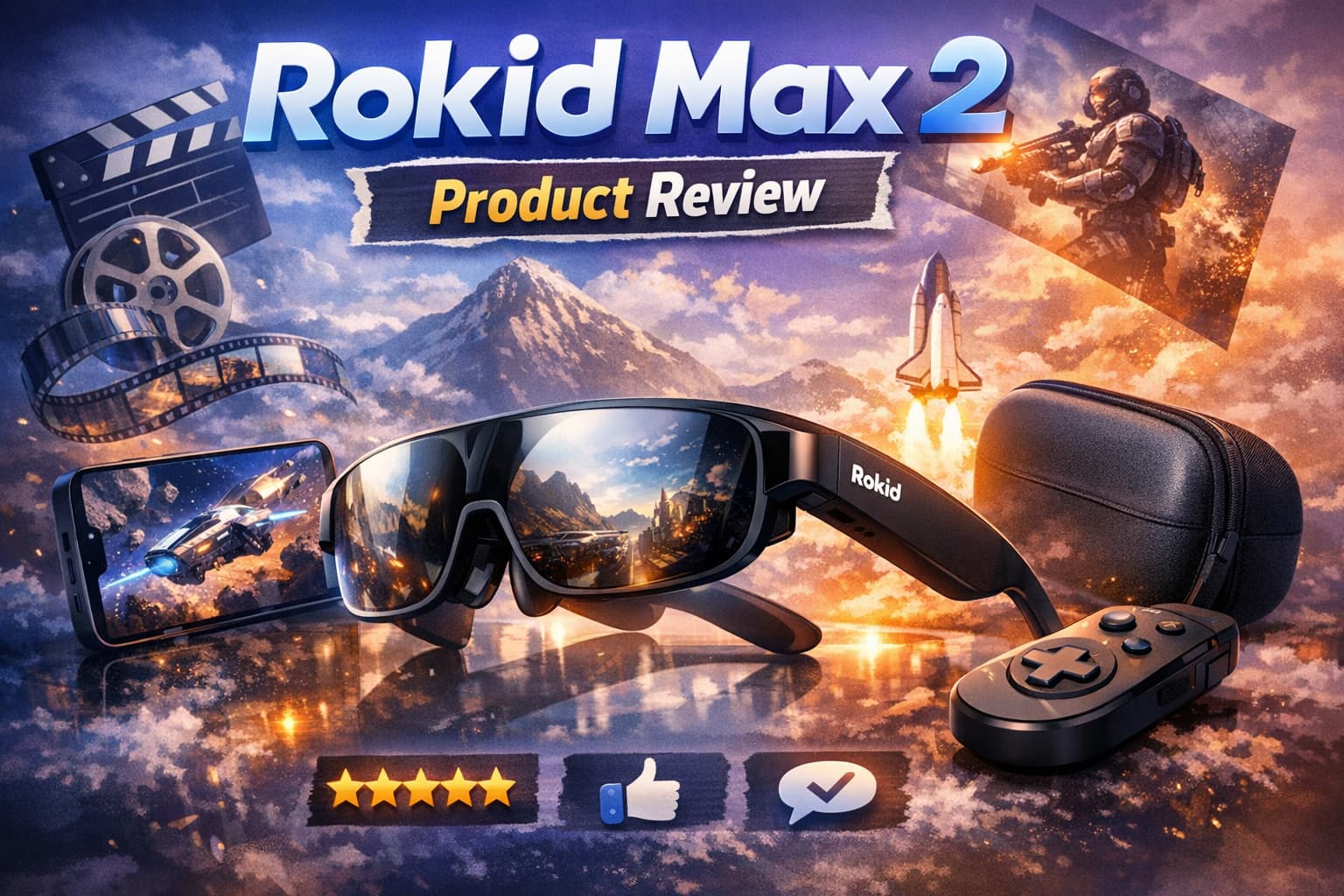
Image source: Rokid
Rokid Max 2 Review: Solid AR Glasses That Shine With the Right Setup
Bottom line: The Rokid Max 2 are well-built AR display glasses that deliver sharp 1080p visuals with a wider field of view than the Xreal Air 2 Pro. They're best experienced with Rokid's own Station 2 processing unit, which adds a standalone Android OS — without it, you're limited to USB-C tethering like the Xreal. If you're buying into the Rokid ecosystem (Glasses + Station 2), you get the best all-around AR package in this price range. Glasses-only buyers get a solid Xreal competitor.
Quick Specs
| Spec | Details |
|---|---|
| Price | $449 (glasses only, regular price) / frequently ~$399 on Amazon |
| Weight | ~75g |
| Display | Dual micro-OLED, 1920×1080 per eye |
| Refresh Rate | Up to 120Hz |
| Field of View | ~50° diagonal |
| Brightness | 600 nits |
| Connectivity | USB-C DisplayPort (glasses only) |
| Diopter Adjustment | -6.0 to +2.0D (wider range than most competitors) |
| Audio | Built-in stereo speakers |
| Compatible | Android phones (DP out), Mac, PC, consoles via adapter, Rokid Station 2 |
| Station 2 Price | ~$219 (processing unit sold separately) |
What's Improved Over the Original Rokid Max
The original Rokid Max was well-regarded. The Max 2 refines the design meaningfully:
- More discreet design — less visually conspicuous than the original
- Lighter — reduced weight for longer wear sessions
- Wider diopter range — -6.0 to +2.0D versus the original's narrower range
- 600 nits brightness — excellent indoor visibility
- Improved hinge and build quality
The display specs (1080p/eye, 120Hz) are similar to the original, which is fine — those were already excellent. The improvements are all in the hardware refinement.
Display Quality
The Max 2's display is the product's strongest feature. At 50° field of view (versus Xreal Air 2 Pro's 46°), the virtual screen feels slightly more immersive — less of a "screen in front of you" and more of a presence in your vision.
The 1920×1080 per-eye micro-OLED panels deliver sharp, high-contrast visuals. Text is readable, colors are accurate, and dark scenes show genuine blacks. The 600-nit brightness is the highest in this category and makes indoor use very comfortable — bright office lighting doesn't wash the image.
At 120Hz, motion is smooth. Games and video feel fluid without the judder that lower-refresh displays show.
The 50° FOV still has visible screen borders — you can see the edge of the virtual screen within your field of vision. It's not a fully immersive display, but it's a noticeable step up from narrower FOV competitors.
The Station 2 Ecosystem
The Rokid Max 2 is the glasses component of a two-part ecosystem. The Rokid Station 2 is a standalone Android processing unit that connects to the glasses:
- Runs a full Android OS (6-core processor, 3GB RAM, 64GB storage)
- No phone required — fully standalone
- Android app compatibility including streaming services, games, YouTube
- Wi-Fi + Bluetooth built in
- Remote control included
- Price: ~$219
With Station 2, the Rokid Max 2 becomes a standalone AR headset — no phone, no laptop, just put on the glasses, pick up the remote, and you have a private 120Hz cinema screen anywhere you go. This is the configuration that earns the highest praise from users.
Without Station 2 (glasses only), you're connecting via USB-C to a phone, laptop, Steam Deck, or console. This still works well and covers most use cases.
Compatibility (Glasses Only)
The Max 2 requires USB-C with DisplayPort Alt Mode for direct connection:
- Mac (M1/M2/M3 and newer): Direct USB-C, works well
- Windows laptops with USB-C DP out: Works, check your device specs
- Steam Deck: Direct USB-C connection, excellent gaming pairing
- Android phones with DP out: Samsung Galaxy S/A series (check model), Google Pixel
- iPhone: Not directly compatible; requires Lightning/USB-C to HDMI adapter + powered hub
- PS5/Xbox/Switch: Requires HDMI capture adapter
Diopter Adjustment
The Max 2's diopter range of -6.0 to +2.0D is the widest in the consumer AR glasses category. Where Xreal Air 2 Pro covers -1.75 to -5.0D and favors nearsighted users, the Max 2 adds farsighted correction and covers stronger prescriptions. For people with -5.0 to -6.0D vision (significantly nearsighted), the Max 2 may be the only AR glasses with built-in correction that works.
Audio
The built-in speakers are similar to the competition — adequate for private use in quiet environments, leaky in public, and not recommended for music you care about. Bluetooth earbuds paired through the connected device are the standard usage pattern for serious audio.
Day-to-Day Use
Travel/planes: Excellent. The 50° FOV and 600 nits make movie watching genuinely cinematic. With Station 2, you have a standalone unit — no laptop needed.
Gaming (Steam Deck): Very strong. Direct USB-C connection, 120Hz support for Steam Deck games, and the wider FOV makes gaming feel more immersive than the Xreal.
Home cinema: The Rokid + Station 2 combination makes the best "portable private cinema" in this price range. Put on the glasses, pick up the remote, access Netflix/YouTube/any Android app.
Work/productivity: The multi-window workspace requires Rokid's Spatial Computing mode. Functional for focused single-window tasks; less polished than Xreal's Nebula for Mac/PC professional use.
Rokid Max 2 vs Xreal Air 2 Pro
The natural comparison since they're priced similarly:
| Feature | Rokid Max 2 | Xreal Air 2 Pro |
|---|---|---|
| Price | $449 | $449 |
| FOV | ~50° | 46° |
| Brightness | 600 nits | 500 nits |
| Diopter Range | -6.0 to +2.0D | -1.75 to -5.0D |
| Tinted Lenses | ❌ No | ✅ Yes (electrochromic) |
| Standalone Option | ✅ Yes (+ Station 2) | ✅ Yes (+ Beam) |
| Mac/PC Software | Limited | Nebula (more mature) |
| Weight | ~75g | ~80g |
Rokid wins on FOV, brightness, and diopter range. Xreal wins on electrochromic tinting and Mac/PC software maturity. Both have standalone processing units available. The Rokid Station 2 is more capable than Xreal's Beam for standalone use.
Pros
- Wider 50° FOV than most competitors in this price range
- 600 nit brightness — best-in-class visibility
- Wide diopter adjustment (-6.0 to +2.0D) covers more prescriptions
- Station 2 ecosystem transforms glasses into a standalone AR device
- 1080p/eye at 120Hz — excellent display quality
- More discreet design vs previous generation
- Lighter than original Rokid Max
Cons
- No electrochromic tinting — limited outdoor use in bright sunlight
- Mac/PC software less mature than Xreal's Nebula
- Station 2 sold separately (+$219) for best experience
- ~75g weight fatiguing for 3+ hour sessions
- USB-C tethered (without Station 2)
- iPhone compatibility requires adapter workaround
- Public appearance — clearly looks like tech hardware
Who Should Buy These
Buy them if you:
- Want the widest FOV in this price category (50°)
- Have stronger nearsightedness (-5.0 to -6.0D)
- Are also buying Station 2 for standalone use
- Primarily use with Steam Deck or Android devices
- Want the brightest indoor display available (600 nits)
- Want home cinema replacement and aren't concerned with Mac workflow
Skip them if you:
- Use a MacBook primarily and want polished multi-window workspace
- Need outdoor/bright light use (lack of tinting hurts here)
- Are on an iPhone and won't use Station 2
- Want standalone use without buying an additional $219 unit
Pricing and Where to Buy
$449 regular price, frequently available at ~$399 on Amazon with discounts. The Rokid Station 2 is ~$219 separately. Bundle pricing is occasionally available — check Rokid's website and Amazon. Global availability has expanded in 2025.
Final Verdict
3.9 / 5
The Rokid Max 2 is a strong AR display glasses product that competes well with the Xreal Air 2 Pro. The wider FOV and brighter display give it an edge for immersive media consumption, and the Station 2 ecosystem creates a genuinely compelling standalone experience.
The lack of electrochromic tinting and less mature Mac software are the main areas where Xreal wins. For Android users, Steam Deck gamers, and people who want or already have the Station 2, the Max 2 is the better choice. For Mac-first users, Xreal's Nebula ecosystem gives a slightly better experience.
Prices current as of June 2025. Check amazon.com and global.rokid.com for current pricing and bundle availability.